
Checking Criminal History in California
No single California search covers a rap sheet, case docket, booking, warrant, prison record, and registry listing. Start with the event and its source. A recent booking belongs with a county jail. A filed prosecution belongs with that county's Superior Court. A state-prison commitment belongs in the California Incarcerated Records and Information Search, or CIRIS. A public registry listing belongs on the California Megan's Law Website. Only the person named in a CA DOJ record may request the complete state summary through the public Record Review process.
Use a case number or agency report number when possible. Public name indexes can return similar names while omitting date of birth and other identifiers. California court rules also make courthouse access broader than remote access for criminal documents. A sound check follows the record from index to source file instead of treating the first online result as the complete history.
- Identify whether the goal is a case, arrest, custody record, registry listing, or your own statewide RAP sheet.
- Find the county of arrest or filing and open its official Superior Court, sheriff, or agency channel.
- Use the exact case, booking, CDCR, ATI, or report number when one is available.
- Compare the result with the source court disposition and note any sealed, missing, or delayed information.
- Use fingerprints for your own CA DOJ Record Review and certified copies when official proof is needed.
Note: A no-result response from one California system does not prove that no record exists in another county, custody, court, or federal system.
Three California Records Often Confused
A booking record, court case file, and CA DOJ RAP sheet can describe the same incident while answering different questions. The jail record documents intake and custody at one place and time. The Superior Court file shows which charges were filed, what happened at each hearing, and how the case ended. CA DOJ compiles fingerprint-linked arrest cycles and the dispositions that agencies report back to the repository.
| Record | Official Source | Key Limit |
|---|---|---|
| Booking record | County sheriff or jail | Shows custody and allegations, not the final outcome |
| Criminal case file | County Superior Court | Does not include arrests that never became filed cases |
| RAP sheet | CA DOJ BCIA | Subject-only public review and may await a reported disposition |
The source file controls the detail. A court order may be the proof needed to correct a disposition that is missing from the state summary.
Inside the California Criminal History Repository
The California Department of Justice is the parent agency. Its California Justice Information Services Division contains the Bureau of Criminal Information and Analysis, the central repository for state summary criminal history. BCIA receives fingerprint-based arrest data, identifying information, booking numbers, charges, reported dispositions, and sentence information. It also maintains biometric systems, exchanges data with the FBI, supports automatic record relief, and publishes aggregate criminal-justice statistics.
Penal Code section 11105 makes summary criminal history confidential and limits who may receive it. California does not offer the public a portal for buying another person's statewide history by name. The public-facing route is a fingerprint Record Review of your own history. The dedicated CA DOJ criminal records agency guide explains the bureau, its products, and the correction process in detail.
County reporting is central to repository accuracy. For a reportable arrest, fingerprints and arrest data travel to CA DOJ and are associated with a California Identification number. The prosecutor and Superior Court then create the filing and disposition records. Penal Code section 13151 directs the court to report specified outcomes, the CII number, and docket number to DOJ within 30 days, yet CA DOJ still warns that court information can be incomplete or missing. When the summary and county file differ, obtain the source order, ask the court to transmit the correction, and use the BCIA 8706 challenge process after reviewing your fingerprint record.
CA DOJ Record Review by Fingerprint
California residents request their own state record with form BCIA 8016RR and a CA DOJ-certified public Live Scan provider. The form asks for legal name, aliases, birth data, physical descriptors, address, identification information, signature, and the Record Review reason. A provider checks valid photo identification, captures fingerprints, and transmits the transaction. The $25 DOJ fee is separate from the provider's variable rolling fee. Eligible California residents may seek a waiver of the DOJ portion, though the provider fee remains.
The official CA DOJ Record Review page shows the fingerprint route and current instructions.
The page reinforces the core California rule: this process is for the subject's own record and is not a public name search. A person outside California uses BCIA 8705 with an FD-258 fingerprint card by mail and pays the same $25 state fee.
California Statewide Record Systems
Statewide systems cover narrow parts of the record landscape. Each must be read according to its jurisdiction. CIRIS concerns current CDCR custody, not a county jail or a complete conviction record. The Megan's Law Website displays only the categories authorized for public release, not the full law-enforcement registry. California's appellate portal covers the Supreme Court and Courts of Appeal, while the 58 Superior Courts retain trial records.
| System | What It Holds | Run By |
|---|---|---|
| CA DOJ Record Review | The subject's fingerprint-linked state summary | CA DOJ BCIA |
| CIRIS | Selected current state-custody and parole-date information | CDCR |
| California Megan's Law Website | Publicly disclosable registry profiles | CA DOJ |
| Appellate Case Information | State appellate dockets, not trial cases | California Courts |
| County Superior Court portals | Trial indexes, calendars, registers, and local summaries | Each Superior Court |
County Jail, CDCR, or Federal Custody
California custody has three distinct layers. County jails hold most people awaiting court, serving eligible local sentences, or awaiting transfer. CDCR receives people committed to state prison, but California's 2011 realignment means some felony sentences are served locally under Penal Code section 1170(h). Federal custody belongs to the Bureau of Prisons. The charge label alone therefore does not tell a searcher which locator to use.
CIRIS accepts a CDCR number or name and displays selected fields such as current age, CDCR number, institution, admission date, commitment county, controlling release or parole-eligibility date, and some Board of Parole Hearings actions. It omits the offense, sentence, photograph, physical description, and full history. A county booking page or sentencing court remains necessary for those source details.
For the federal layer, the BOP Inmate Locator covers federal custody and release records, with its strongest electronic coverage after 1982.
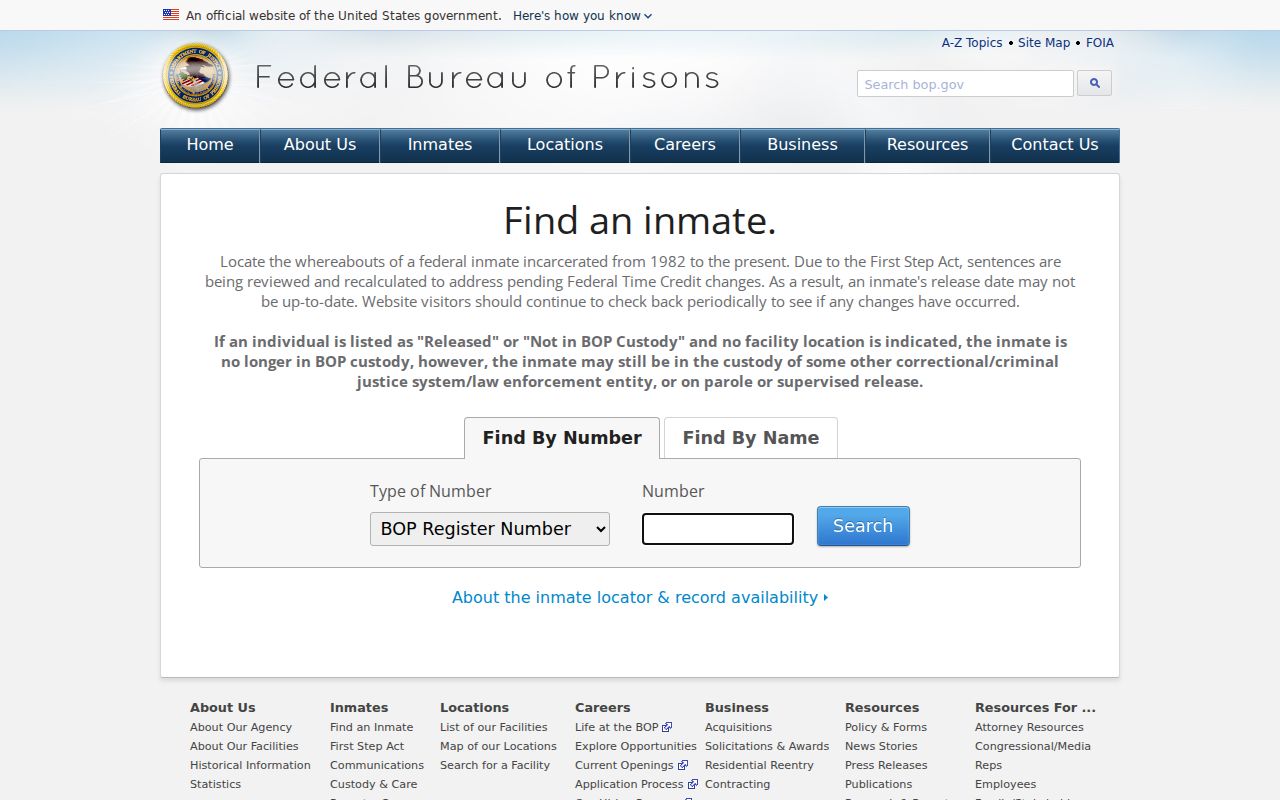
The federal result is a separate custody record. It does not replace a California Superior Court case, a county jail roster, or CIRIS.
Types of California Criminal Records
California records are created at different steps of a case. Knowing the creator helps locate the current, authoritative version and explains why one search can omit an event found elsewhere.
- Arrest and incident reports remain with the sheriff, police, CHP, campus, or special agency that investigated.
- Booking and jail records are county custody records and do not prove guilt.
- Criminal court case files sit with the Superior Court that received the prosecution.
- Summary criminal history is the confidential fingerprint-linked CA DOJ compilation.
- Warrant and supervision records arise through a Superior Court, county probation, BPH, or CDCR DAPO process.
- Registry listings are the public portion of data supplied by local registering agencies to CA DOJ.
California Warrants, Probation, and Parole
California has no public statewide warrant-name search. Arrest and bench warrants arise in a Superior Court, and search warrants may remain sealed during an investigation. A person checking their own possible warrant should identify the county, review the official court register for a warrant or recall event, and confirm the case number and status with the issuing court. CLETS and national law-enforcement systems are not public portals, while a CPRA request is not a guaranteed path to an active warrant.
Probation is also local. A Superior Court imposes it, and a county probation department administers it. Parole is state-run: the Board of Parole Hearings handles suitability proceedings, while CDCR's Division of Adult Parole Operations provides field supervision. A technical supervision violation is not automatically a new conviction, and operational notes are not generally public. The docket, CIRIS, published BPH information, and the relevant official agency each cover a different part of the status.
California Public Access Laws
The California Public Records Act, Government Code section 7920.000 and following, governs state and local agency records subject to exemptions and other confidentiality laws. It does not open CA DOJ summary criminal history. Court records operate under judicial access rules instead. Rule of Court 2.503 generally permits remote access to criminal calendars, indexes, and registers while reserving ordinary criminal case documents for courthouse inspection.
Key California authorities:
Penal Code §11105 defines state summary criminal history and limits its dissemination.
Penal Code §§11120-11127 create the fingerprint-based personal review and challenge process.
Rule of Court 2.503 explains why remote criminal access is narrower than courthouse access.
Government Code §7920.000 et seq. establishes the CPRA framework without overriding record-specific confidentiality.
Penal Code §851.93 provides automatic arrest-record relief for qualifying entries.
California Expungement and Record Relief
California often uses the word expungement for a Penal Code section 1203.4 dismissal, but the remedy is not literal deletion. A dismissed conviction stays in the court history, can remain available to authorized users, and may count as a prior under applicable law. Other remedies include petition-based arrest sealing under section 851.91, automatic arrest relief under section 851.93, automatic conviction relief under section 1203.425, felony reduction under section 17(b), certificates of rehabilitation, and pardons.
The filing happens in the Superior Court that handled the case. Statewide forms do not replace county filing, service, and fee instructions. The California Courts record-cleaning guide helps identify the type of relief that may fit a person's own case.
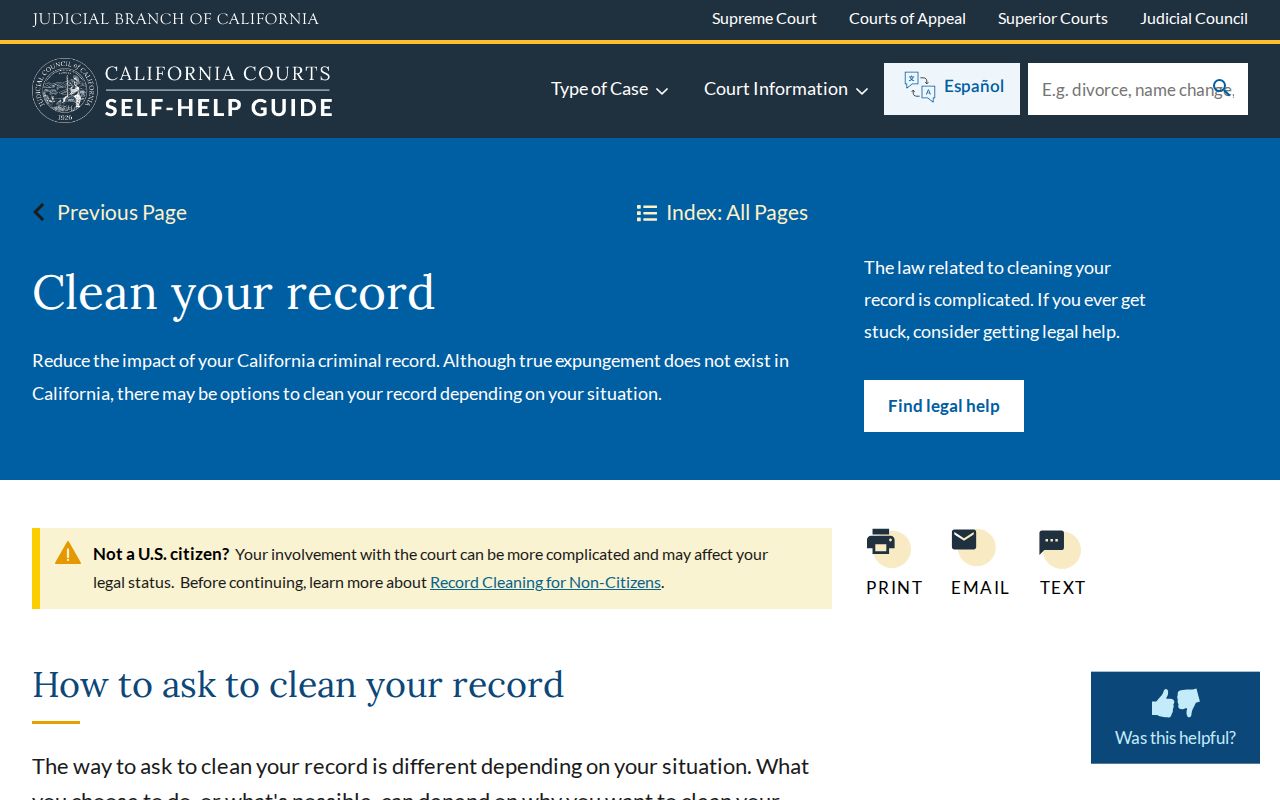
The guide separates dismissal, arrest sealing, and other remedies so users do not mistake every form of relief for record destruction.
California Courts also provides an official search for record-cleaning forms, including CR-180 for dismissal and CR-409 for arrest sealing.
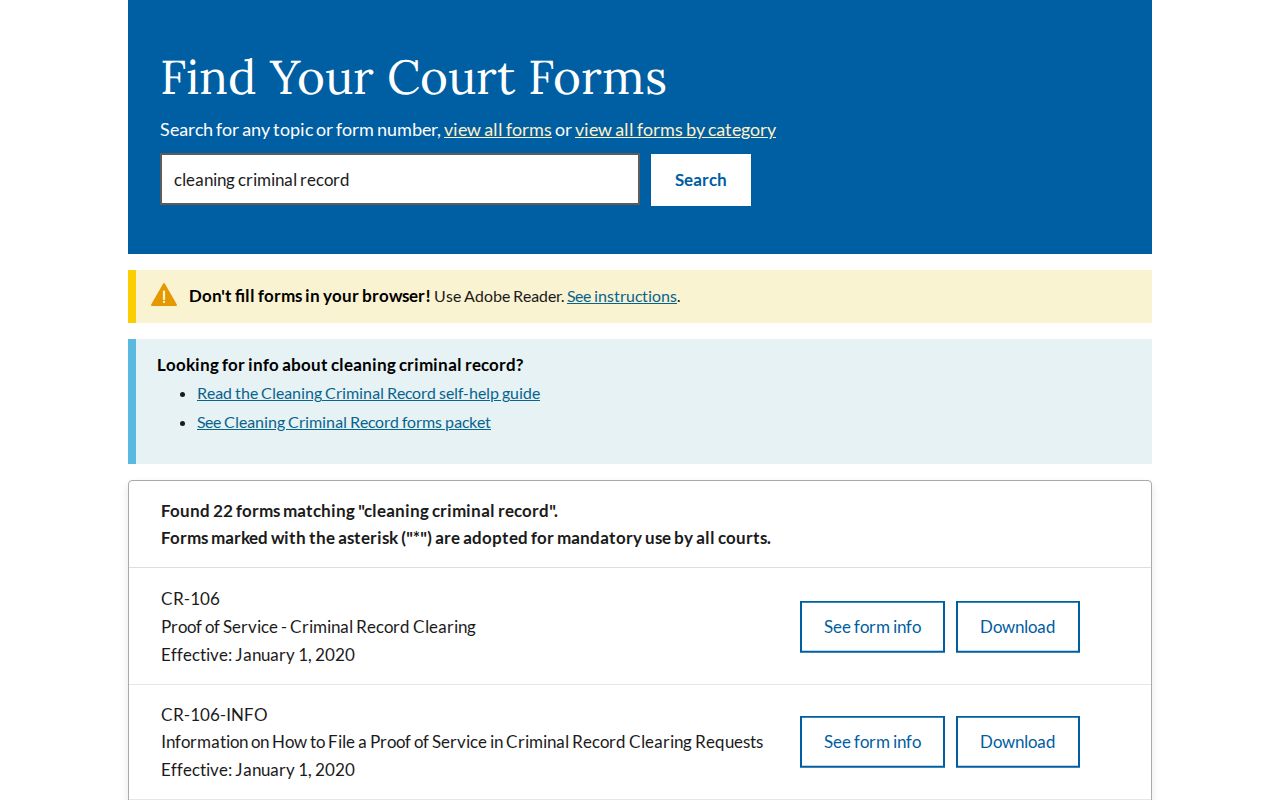
After an order, allow time for court and DOJ reporting, then use a new fingerprint Record Review to verify the state notation when accuracy matters.
California Police and CHP Reports
Local incident reports stay with the agency that investigated. A focused CPRA request should identify the report number, date, place, involved party, and requested portion. An agency may redact or withhold active-investigation material, juvenile information, victim details, medical data, confidential sources, addresses, and other identifiers. Asking for reasonably segregable portions can help define the request without suggesting that every report must be released in full.
CHP uses a separate process for collisions it investigated. Form CHP 190 identifies the collision, involved driver or owner, party-of-interest category, requester, address, and signature. The first 25 pages cost $10, with another $10 for each additional block of up to 25 pages. A photo ID is attached, or the signature must be notarized.
The official CHP 190 page explains the party-of-interest and request routes.
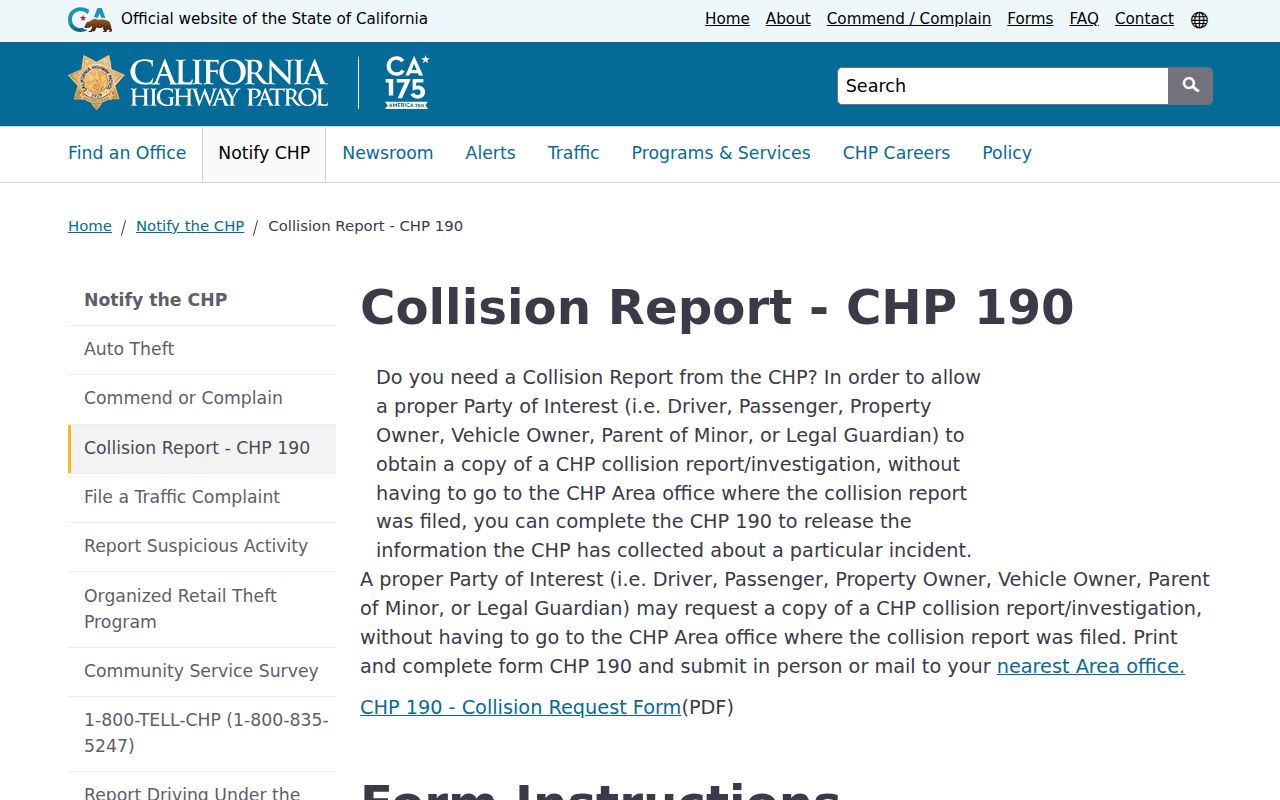
This channel covers CHP-investigated collisions only. A city police or sheriff report must come from that local agency.
California Criminal Record Fees
Charges depend on the product and source. A fee for a state self-review does not buy a court file, while a local index fee does not include certified documents. Confirm local copy costs before ordering.
| Channel | Official Amount | Important Limit |
|---|---|---|
| CA DOJ Record Review | $25 plus rolling fee | Subject's own California summary |
| Fee-waived Record Review | $0 DOJ fee | Provider rolling fee remains |
| FBI Identity History Summary | $18 plus fingerprint cost | Subject-only federal and national submission history |
| CHP collision report | $10 per first 25 pages | Only CHP-investigated collisions |
| Lengthy court index search | $15 after ten minutes | Local online, copy, and certification fees can differ |
| CIRIS and Megan's Law searches | $0 | Selected public information, not a full report |
California Record Terms in Plain Language
California dockets and summaries use compact terms. Their meaning can change which source or next step is useful.
- CII number
- The California Identification number tied to a fingerprint-based DOJ identity record.
- ATI number
- The Applicant Transaction Identifier used to track a Live Scan submission, not to display record contents.
- RAP sheet
- The Record of Arrests and Prosecutions compiled by the repository, not the court's underlying file.
- Disposition
- The reported outcome of a charge or case, such as dismissal, conviction, or acquittal.
- Wobbler
- An offense that can be treated as a felony or misdemeanor under California law and case circumstances.
- Register of actions
- The court's event list showing filings, hearings, orders, and disposition activity.
Criminal Records by County in California
Arrests, booking records, incident reports, trial files, warrants, and probation records are created or administered locally. California's largest counties use distinct court and sheriff systems, just as smaller counties do. These featured routes lead to county homepages, where the correct local source can be identified without treating one metro portal as a statewide database.
Los Angeles County
Los Angeles · Largest statewide volume of decentralized court and custody records
San Diego County
San Diego · Major county with distinct state and federal record routes
Orange County
Santa Ana · Metro court and jail records remain county-specific
Riverside County
Riverside · Fast-growing county with several court and custody locations
San Bernardino County
San Bernardino · Vast county where official location routing is essential
Santa Clara County
San Jose · Bay Area trial and sheriff records use county systems
Alameda County
Oakland · Court, sheriff, and city-police records are separate sources
Sacramento County
Sacramento · State headquarters do not replace the local trial court
Browse the full directory of all 58 California counties to open the criminal records site for any county.