
What the California Department of Justice Is
The California Department of Justice is the parent department. Within its California Justice Information Services Division, the Bureau of Criminal Information and Analysis, or BCIA, is the central repository. Penal Code section 11105 directs DOJ to maintain the Attorney General's master record of identifying data, fingerprints, photographs, arrest dates, agencies, booking numbers, charges, dispositions, and sentences.
BCIA also serves as California's state identification bureau. It manages fingerprints, palm prints, and unsolved latent prints, exchanges custody and disposition data, supports authorized fingerprint checks, and sends California fingerprint data to the FBI. This role makes CA DOJ the statewide compiler, not the creator of every source document. Police, sheriffs, prosecutors, probation agencies, and Superior Courts create and report the events that BCIA joins into a summary record.
The CA DOJ fingerprint program overview shows how fingerprint services connect the repository and official response channels.
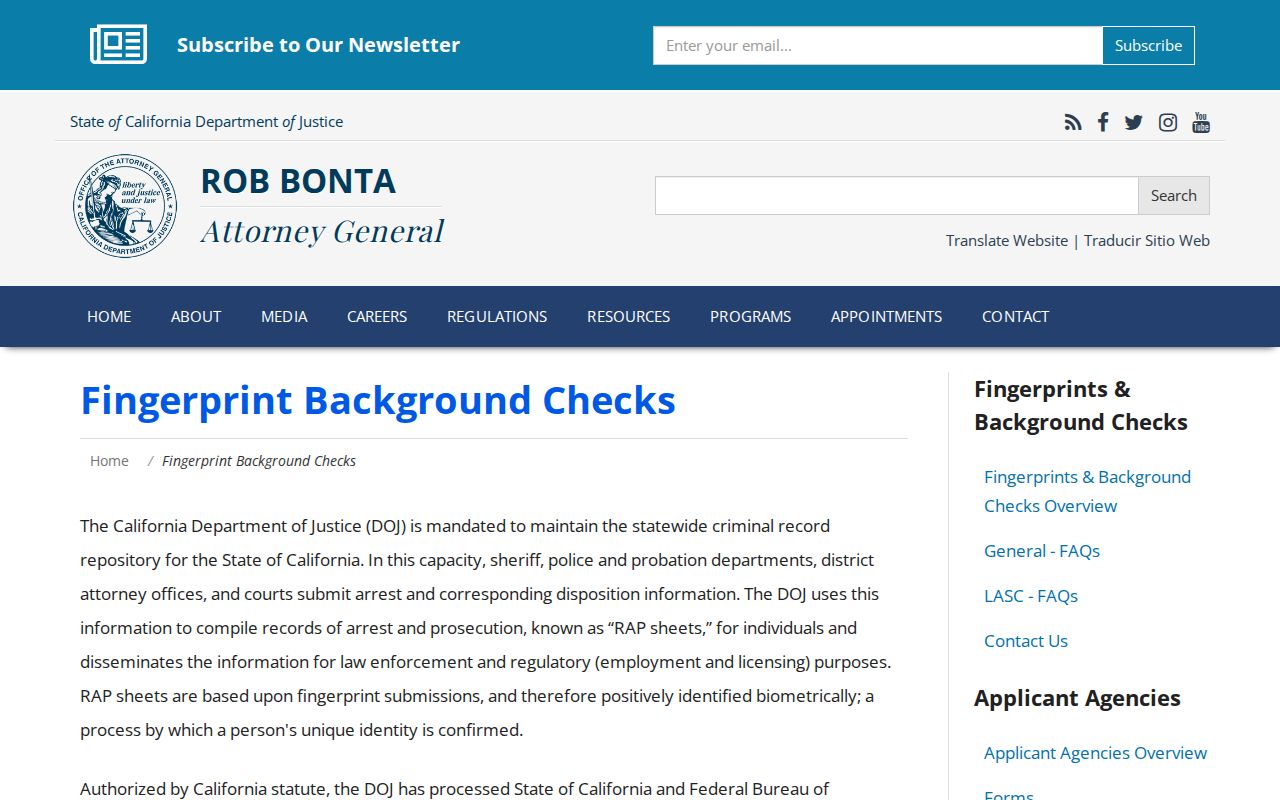
The overview reflects the repository's biometric foundation and its limited, law-based release rules.
How CA DOJ Divides BCIA Work
CA DOJ's June 2026 BCIA fact sheet identifies three branches. Applicant & Record Quality Services manages applicant services, record review, reporting quality, and related support. Records & Biometric Identification operates the biometric identification side. Records Management maintains criminal-history information and carries out required record actions.
- Applicant & Record Quality Services
- Supports authorized responses, personal review, record quality, and contributing agencies.
- Records & Biometric Identification
- Links identity to fingerprints and other biometric records rather than relying on names alone.
- Records Management
- Maintains repository entries and implements required purge, seal, destruction, and relief actions.
Together, the branches support more than storage. They help exchange dispositions, process automatic relief, audit authorized users, train agencies, and supply public criminal-justice statistics. BCIA is therefore both a repository and the operating bridge among local contributors, authorized recipients, and federal identification systems.
Note: BCIA is the California repository bureau, while CJIS is the larger CA DOJ division in which that bureau operates.
CA DOJ Criminal History Check Options
California does not sell a public conviction search by name. The official public route is a subject-only Record Review. An authorized agency may submit fingerprints when a statute permits a particular check, but that response can be narrower than the full record mailed to the person for accuracy review. Status tracking is a separate free service and never reveals record contents.
| Product | Who may order | What it returns | Cost |
|---|---|---|---|
| California Record Review, BCIA 8016RR | The record subject in California | Full California summary history available for personal accuracy review | $25 DOJ fee plus variable rolling fee |
| Out-of-state Review, BCIA 8705 and FD-258 | The record subject outside California or the United States | The same subject-only California summary based on hard-card fingerprints | $25 plus local card and mailing costs |
| Record Review fee waiver | Qualifying California resident | Same personal Record Review | $0 DOJ fee; rolling fee remains |
| Formal challenge, BCIA 8706 | Subject after receiving a Record Review | Investigation of claimed inaccuracy or incompleteness | No separate published challenge fee |
| Authorized fingerprint response | Agency authorized by statute | Only the criminal-history information the statute permits | DOJ and FBI fees vary; rolling fee extra |
| Applicant Background Check Status | Fingerprint subject with ATI and birth date | Processing status only | Free |
Note: Applicant Status is a transaction tracker, not another CA DOJ criminal history product and not a way to read a response.
Why CA DOJ Rejects Public Name Searches
Penal Code section 11105 makes state summary criminal history confidential and limits who may receive it. A member of the public cannot type another person's name into a CA DOJ portal and buy a rap sheet. Fingerprints give the repository positive identity and reduce the risk of attaching one person's arrest to another person with the same or a similar name.
This rule also explains why a California Public Records Act request is not a workaround. CA DOJ's public-records channel handles records open under that law, but summary criminal histories remain subject to the Penal Code limits. A person who needs their own complete California record uses Record Review. Someone researching a public case uses the Superior Court in the county where it was filed.
Note: A public county case index and a confidential CA DOJ summary serve different purposes, even when both refer to one event.
How Records Reach CA DOJ
An arresting agency creates the arrest record, and a receiving jail creates the booking record. For a reportable arrest, fingerprints and arrest data travel to BCIA, often by Live Scan. CA DOJ associates the event with the person's biometrics and California Identification number. The prosecutor then decides whether to file, and the Superior Court creates the authoritative case file.
Data flow: County Arrest › Fingerprint Submission › California Department of Justice › Court Disposition Reporting › Rap Sheet
Penal Code section 13151 requires a Superior Court to report the disposition, CII number, and docket number to DOJ within 30 days. That deadline does not prevent lag or omissions. DOJ acknowledges that court information can be incomplete, inaccurate, or missing. The state summary can lack a disposition already present in the county file, while a court index can omit an arrest that never became a filed case.
CA DOJ Live Scan and 8016RR
A California resident starts with the current BCIA 8016RR, Request for Live Scan Service. The ORI is prefilled for Record Review. The person checks Record Review, gives the requested identity and contact details, signs the form, and takes it with valid unexpired photo identification to a certified public Live Scan provider. DOJ charges $25. The provider sets a separate rolling fee.
| Identity | Legal name, middle initial, suffix, aliases, birth date, sex, and place of birth |
|---|---|
| Description | Height, weight, eye color, and hair color |
| Identifiers | Driver license and state if available; Social Security number is voluntary unless another rule controls |
| Contact | Home address, city, state, and ZIP |
| Service controls | ORI, application type, reason, level of service, and agency routing fields |
| Submission | Applicant signature and date, identity check, fingerprints, payment, and ATI receipt |
The CA DOJ Record Review instructions set out the fingerprint steps and fee.
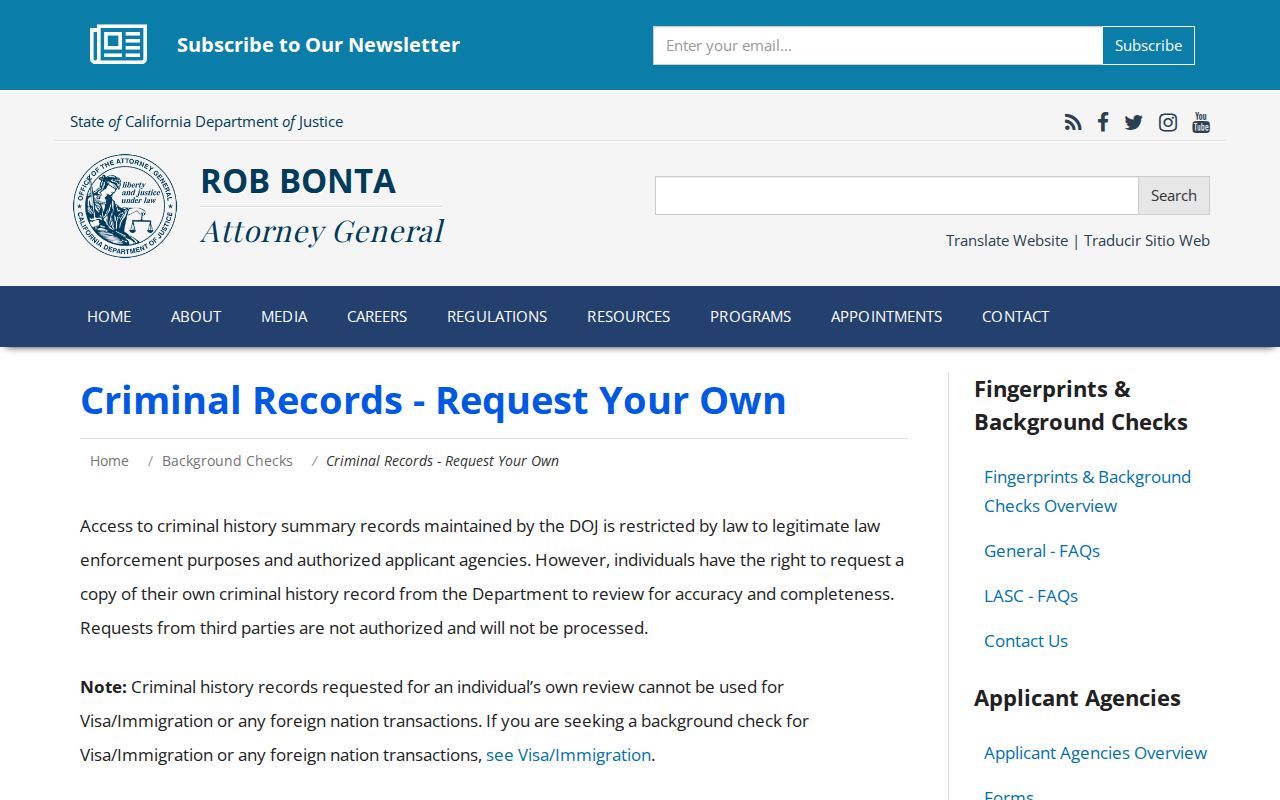
The official screen reinforces that Record Review is for the subject's own California history and challenge rights.
Ordering a Check From CA DOJ
The route depends on location. California residents submit Live Scan fingerprints. A person outside California or outside the United States uses a standard FD-258 fingerprint card with BCIA 8705 and mails the package as directed. Either path requests the subject's own California record. Processing times vary, so CA DOJ does not promise one fixed turnaround.
- Download BCIA 8016RR for in-state Live Scan, or use BCIA 8705 with FD-258 from outside California.
- Complete the identity fields and obtain valid fingerprint impressions through the proper local channel.
- For Live Scan, select a provider, confirm its hours, appointment policy, fee, and payment types, then retain the ATI number.
- Pay the $25 DOJ fee unless an approved waiver applies. Out-of-state applicants follow the current form's payment and mailing directions.
- Read the mailed Record Review and compare each arrest cycle and disposition with its county source file.
CA DOJ Live Scan Location Details
The official public Live Scan finder filters certified providers by any of California's 58 counties. Result rows show a name and location, contact details, mobile service, hours, appointment or walk-in status, rolling fee, payment methods, and whether the site serves only transactions with an agency billing number.
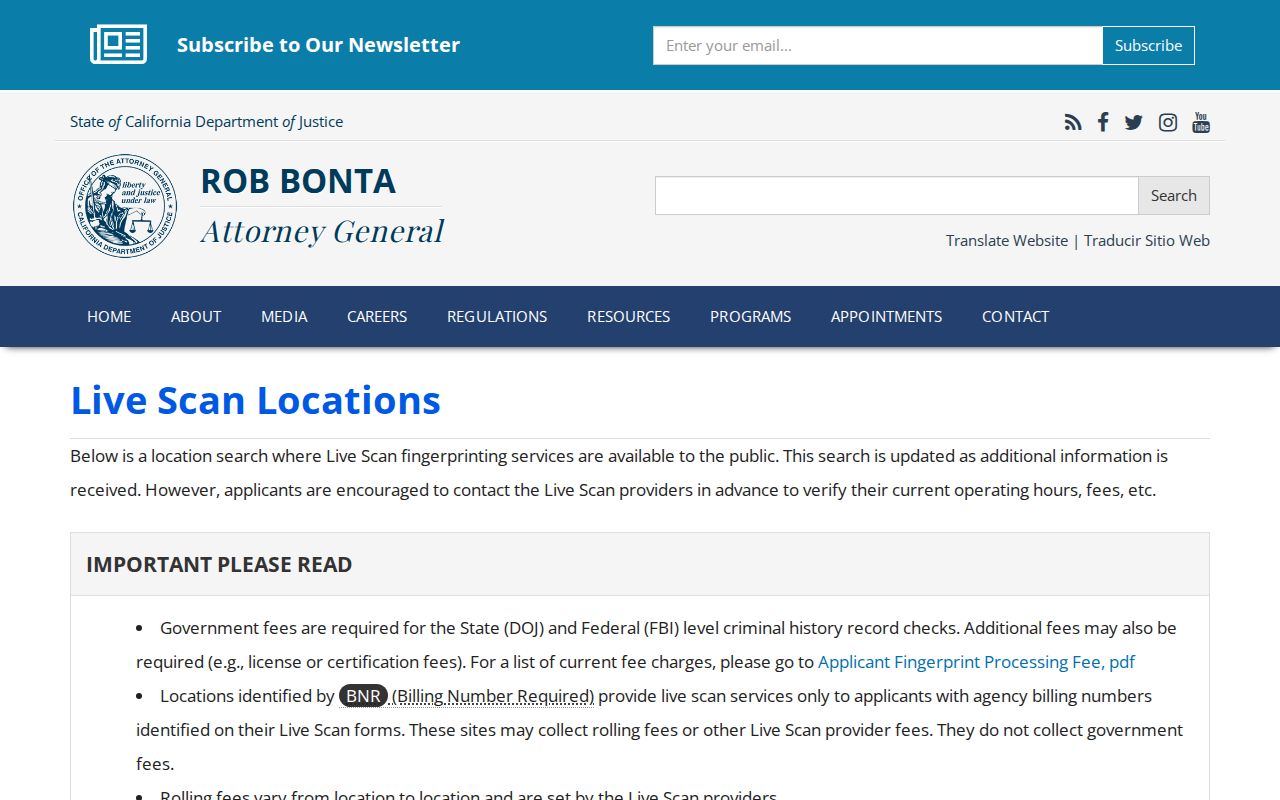
The county selector demonstrates why California has a certified network rather than one exclusive statewide private vendor.
Call before visiting. Provider schedules and fees can change. A BNR listing means the site works with an agency billing number and does not collect the government portion from the person being printed. Other providers may accept cash, checks, money orders, cards, or account billing. An approved fee waiver removes only DOJ's $25 charge, not the provider's rolling fee.
CA DOJ Applicant Status Limits
Applicant Background Check Status answers one narrow question: whether CA DOJ has processed a submitted fingerprint transaction. The form requires the ATI number from the Live Scan receipt, date of birth in month/day/year form, a reCAPTCHA response, and Submit. It does not show charges, dispositions, a rap sheet, or the receiving agency's final action.
The CA DOJ Applicant Status portal displays those transaction controls.
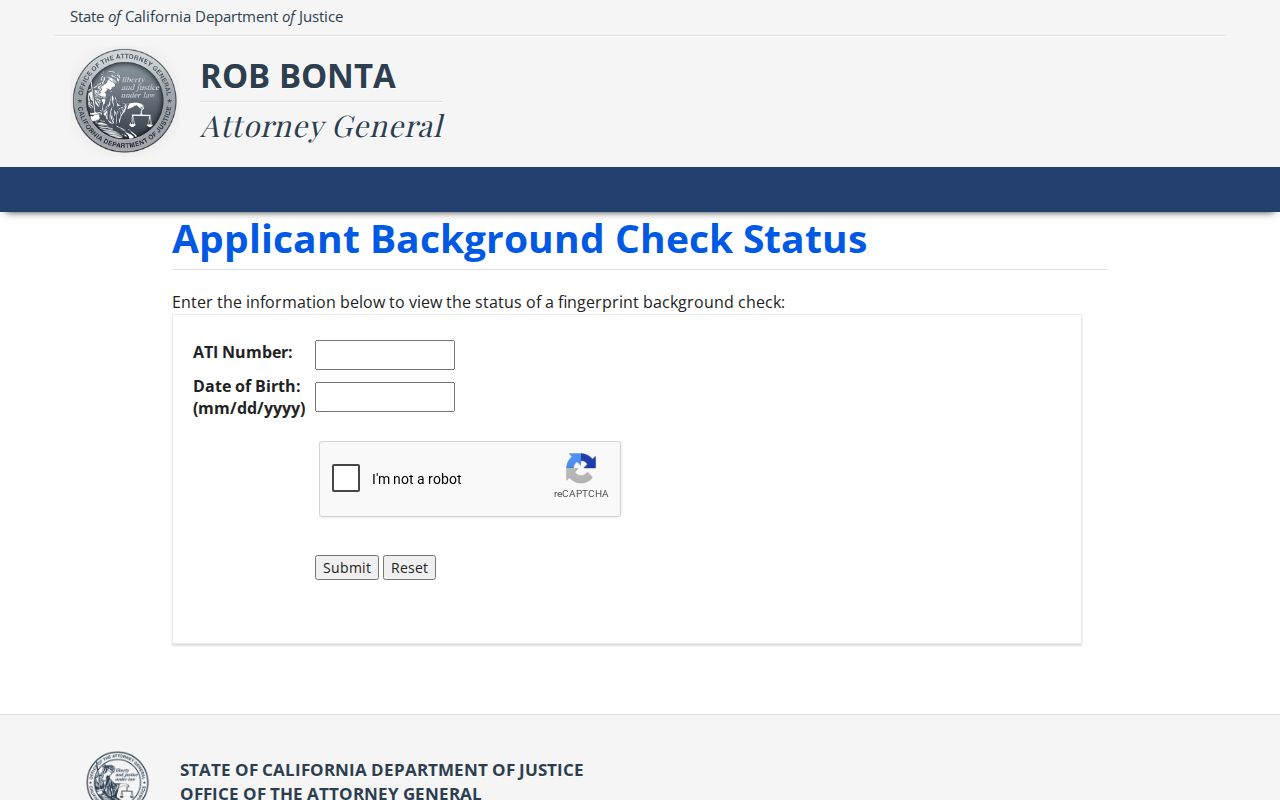
The simple form makes the key limit visible: ATI plus birth date tracks transmission, not record contents.
Keep the ATI receipt until processing is complete. If the goal is to inspect or correct the full California summary record, Applicant Status is not enough. The person must complete the subject-only Record Review path and wait for the response mailed by CA DOJ.
County Records vs CA DOJ Checks
A CA DOJ rap sheet compiles reportable events from across California and ties them to fingerprints. County files preserve the source material. Neither replaces the other. A statewide summary is useful for finding arrest cycles associated with the subject, while the local docket, minute order, dismissal, booking file, or agency report supplies the detail and proof needed to understand or correct an entry.
| Question | CA DOJ check | County record |
|---|---|---|
| Coverage | Reportable statewide summary | One county's source events and files |
| Identity basis | Fingerprint-linked California record | Name, case number, booking number, and local identifiers |
| Detail | Arrest, charge, disposition, and sentence summary fields | Docket activity, orders, documents, booking data, and reports |
| Timing | Depends on contributor reporting and matching | Updates as the local case or custody event moves |
| Correction role | BCIA reviews the compiled state entry | Originating court or agency verifies and retransmits source facts |
Use the California County Directory to locate the Superior Court or records channel where the event occurred. The county file is the decisive source when the dispute concerns what the court ordered or how the local agency recorded the event.
CA DOJ Automatic Record Relief
CA DOJ runs monthly reviews under Penal Code sections 851.93 and 1203.425. Eligible arrest and conviction entries are marked for relief, and DOJ electronically notifies the Superior Court. The 2023 to 2024 biennial report says this work reviewed about 12 million subject records and 55 million arrest cycles each month. More than 12 million arrest and conviction events had received relief by June 2024.
Automatic relief changes dissemination. It does not mean every source paper, police report, or court file has been physically destroyed. Prosecutors and law-enforcement agencies keep separate records under their own rules. Data quality also matters. A missing disposition can affect eligibility processing, which is another reason to compare a fresh Record Review with the county source.
California relief is data-driven. Monthly CA DOJ review can update the state summary, while separate local records may remain under different access and retention rules.
Fixing Errors in a CA DOJ Record
Penal Code sections 11120 through 11127 create California's personal review and challenge process. Common issues include a missing disposition, an inaccurate charge or outcome, a mistaken identity link, or an entry that should show relief. CA DOJ will not resolve the complete history from an Applicant Status result. The person must first obtain the fingerprint-based Record Review.
- Request and receive the CA DOJ Record Review, then mark the exact arrest cycle or disposition at issue.
- Obtain a certified docket, minute order, dismissal, or other source proof from the Superior Court or contributing agency.
- Complete BCIA 8706, Claim of Alleged Inaccuracy or Incompleteness, supplied with a record that contains criminal information.
- Submit the claim and proof to the Record Review Unit. A court-origin problem may require the court to transmit corrected data to BCIA.
- Order a later Record Review to confirm that the correction or relief notation now appears.
BCIA's Record Review & Challenge Section receives mail at P.O. Box 160207, Sacramento, CA 95816-0207. The research lists recordreview@doj.ca.gov and (916) 227-3849 for Record Review. Use those channels for the state summary. Use the originating county for the source fact.
CA DOJ Repository Scale and History
California's criminal-identification framework grew from fingerprint files into electronic biometric and county reporting systems. The Criminal Justice Statistics Center was known as the Bureau of Criminal Statistics before 1991. Its Monthly Arrest and Citation Register electronic data extend from 1980 forward. Modern BCIA now connects Live Scan, biometric identification, criminal-history maintenance, automatic relief, and federal fingerprint exchange.
From January 2023 through June 2024, DOJ reported 3.9 million California-level and 2.6 million federal-level fingerprint-check requests. It also reported 2,745 newly authorized agencies, more than 1,463 agency audits, and 4,854 people trained through 200 rap-sheet sessions. The 2026 fact sheet says BCIA serves more than 20,000 authorized organizations. Those figures show the scale of the repository without claiming an unsupported statewide disposition-completeness rate.