
Criminal Court Cases in California
California uses one unified trial-court system. The Superior Court of California hears felony, misdemeanor, and infraction matters in each county. It also handles preliminary hearings, warrants, pleas, trials, sentencing, and specialty calendars. Older references to municipal courts can mislead a search. Those courts were unified with the Superior Courts, so a present-day California trial record belongs with the Superior Court in the county where the prosecution was filed.
The clerk keeps the official case file and register of actions. That county source is authoritative for filed charges, court orders, and the final disposition. A local case portal may expose a summary, but California does not combine all trial cases in one public database. The six Courts of Appeal and California Supreme Court maintain separate appellate records. Those appellate dockets cannot stand in for the trial file.
Searching 58 California Superior Courts Without a Statewide Trial Portal
The Judicial Council's Find My Court service is the official starting point. Select the county where charges were filed, open that Superior Court's site, and find its criminal case-information page. A residence address alone may point to the wrong place. The filing county controls the court record.
The official Find My Court screen shows how California routes searches across its 58 separately administered trial courts.
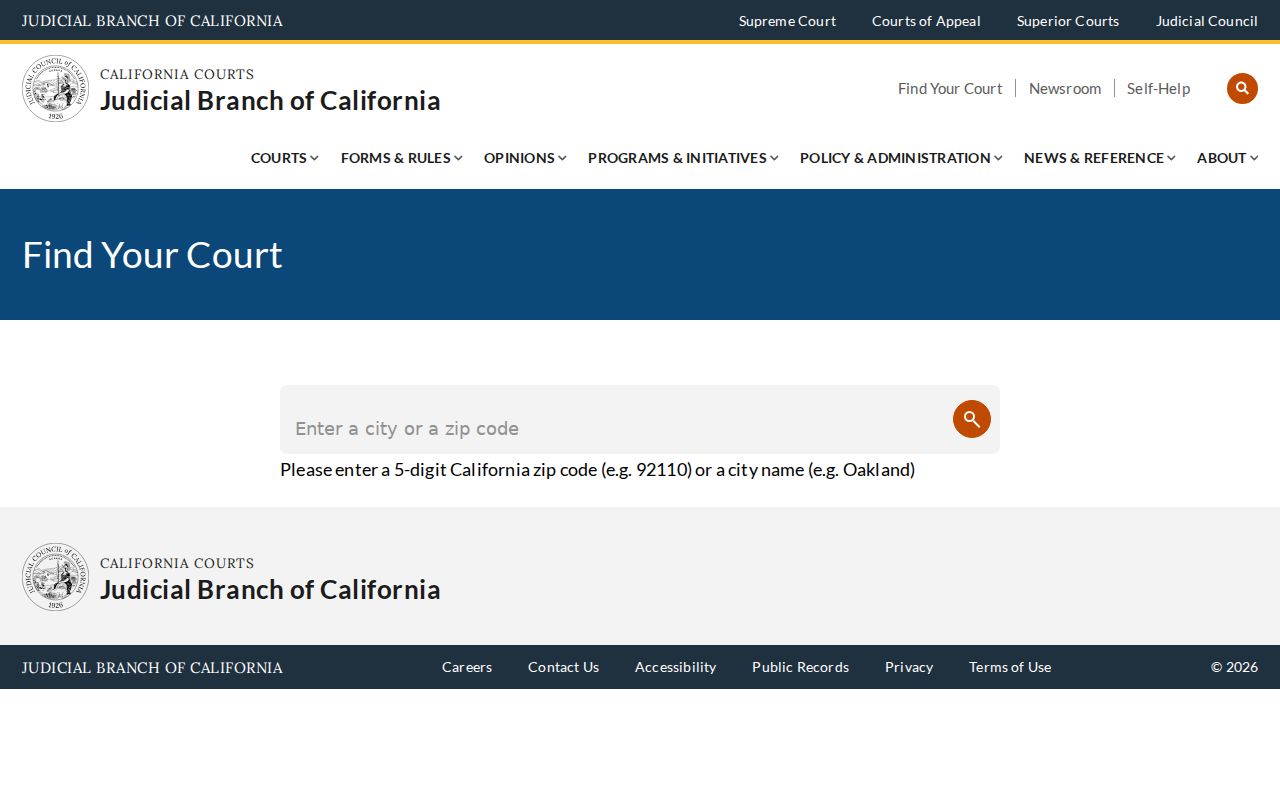
That route matters because portal design, coverage years, name-search rules, and copy methods differ by court. Courthouse locations and criminal divisions can also be spread across a county. The court site identifies the right service point.
Note: Find My Court is a directory to California courts, not a combined search of every Superior Court criminal index.
Searching California County Court Portals
A California criminal court case search should use a case number first. It narrows the result and avoids common-name matches. When only a name is known, check spelling and aliases, then treat the result as a lead until the case number and other reliable facts align. A practical search uses both the online index and the clerk when the portal is incomplete.
- Identify the county of filing and use Find My Court to reach that Superior Court.
- Open the official criminal case portal. Enter the case number when known, or use the court's defendant-name option.
- Record the filing location, charges, status, next hearing, and disposition shown in the register.
- Use a courthouse public terminal when criminal documents are not available remotely or an older case is absent.
- Ask the criminal clerk for a plain or certified copy by the court's counter, mail, or approved online method.
California's statewide Appellate Case Information system is useful only after a case reaches a Court of Appeal or the Supreme Court. It is not a statewide Superior Court search.
| Appellate field | Control | Required | Scope |
|---|---|---|---|
| Court | Dropdown | Yes | Supreme Court or one Court of Appeal district and division |
| Search type | Tabs or options | Yes | Case number, party, attorney, or available caption terms |
| Case number or name | Text | Depends | Accepts appellate identifiers and parties only |
| Date range or status | Filter | No | Narrows appellate docket results |
| Search or Clear | Buttons | No | Runs or resets the appellate query |
California Rule 2.503: Why the Docket Is Online but the Filing Is at the Courthouse
Online access is not the same as public access. California Rule of Court 2.503 requires reasonable access to electronic records, yet it generally bars remote public access to documents filed in criminal proceedings. A portal may still display calendars, indexes, and a register of actions. The complaint, minute order, judgment, or other document may remain available only at a courthouse terminal or through a clerk copy request.
Sealed and confidential matters create a separate limit. Juvenile cases, protected personal identifiers, and records sealed by law are not opened merely because someone visits a terminal. For an ordinary public file, ask the clerk which source document supports the summary entry rather than assuming the web view is complete.
Note: Courthouse access can be broader than remote access, but it does not override a California sealing order or confidentiality law.
Inside a California Criminal Case File
A California criminal case file records what the prosecutor charged and what the court did. The header usually identifies the case number, filing date, location, case level, status, and judicial officer. Charge rows may show the count, code section, offense level, plea, verdict, and disposition. The register then traces hearings, motions, warrants, trial events, and sentencing.
| Case number and court | Connects every entry to the filing location and the correct California Superior Court file. |
|---|---|
| Charging documents | The complaint, information, or indictment states the formal accusations and code sections. |
| Register of actions | Lists filed events such as arraignment, pleas, motions, warrant activity, trial, and judgment. |
| Hearing dates | Shows past proceedings and any future calendar date published by the court. |
| Disposition | Records dismissal, acquittal, conviction, diversion outcome, or another result for each charge. |
| Sentence and judgment | May state custody, probation, fines, restitution, credits, and other terms, with full detail in source orders. |
Arrest reports and booking records are separate. An arresting agency holds the narrative, while a jail keeps the custody intake. The California case file may refer to an arrest without containing either complete source record.
How to Read a California Register of Actions
The register of actions is the chronological docket. It helps a reader see whether a charge advanced, changed, or ended. A complaint starts the court prosecution. An arraignment is the hearing where charges are stated and a plea is entered. In a felony case, a preliminary hearing can test whether enough evidence exists to proceed, followed by an information if the prosecution continues.
- Disposition
- The recorded outcome of a charge or the whole case.
- No contest
- A plea that supports a conviction without the same admission used by a guilty plea in every other setting.
- Own recognizance
- Release without posting money, based on a promise to appear and any court conditions.
- Bench warrant
- A warrant issued by a judge, often after a missed appearance or failure to comply.
- Concurrent sentence
- Two or more sentences run at the same time rather than one after another.
A docket line is not always the whole ruling. If an entry says a motion was granted or a charge was dismissed, request the minute order or judgment for the exact terms. That source is stronger than a shorthand label.
How a California Criminal Case Moves
The record grows as the case moves. A prosecutor-filed complaint creates the first court charging document. At arraignment, the court records a plea and release terms. Felony matters may add a preliminary hearing and information. Pretrial motions can change evidence or charges. A plea or trial produces the outcome, and the judgment and sentencing orders state the court's final action.
Case flow: Charges Filed › Arraignment › Pretrial › Plea or Trial › Disposition › Sentencing
Diversion can pause the usual path and may end in dismissal after program completion. A notice of appeal starts a new appellate record, but it does not move or replace the county trial file. The original Superior Court still holds the pleadings, minute orders, and judgment.
Note: A pending status does not show the outcome. Check later docket entries and the judgment before describing a California criminal case as resolved.
Felony and Misdemeanor Appeals Take Different California Paths
California appeal routes depend on the trial matter. Felony judgments and appealable orders generally go from the Superior Court to one of six Courts of Appeal. Misdemeanor and infraction appeals usually begin in the Superior Court's appellate division. A later transfer or review process may bring a limited-jurisdiction matter to a Court of Appeal.
| Case level | First review court | Next possible review |
|---|---|---|
| Felony | California Court of Appeal | California Supreme Court by petition for review |
| Misdemeanor or infraction | Superior Court appellate division | Transfer or other review may reach a Court of Appeal |
| Death judgment | California Supreme Court | Federal review may follow on federal issues |
The appellate portal can show appellate briefs, docket events, and opinions when available. To understand the evidence, original charges, or local sentence, return to the originating Superior Court case number.
Note: An appellate case number identifies the review proceeding and should not be substituted for the original California Superior Court number.
Court File Versus CA DOJ RAP Sheet: Which Disposition Controls?
The county court file and a CA DOJ RAP sheet answer different questions. A court file is the source for the filed case and its orders. A RAP sheet is a fingerprint-linked statewide summary of arrest cycles and dispositions reported to the California Department of Justice. It can join events from several counties, but it does not contain the full pleadings or evidence.
When a CA DOJ record lacks a disposition that appears in the county judgment, use the certified court record as proof of what the court decided. Courts and justice agencies report dispositions under Penal Code section 13151, yet a late or missing update can occur. A person reviewing their own history may obtain a fingerprint-based CA DOJ Record Review and challenge an incomplete entry with source documents.
Public access also differs. Under Penal Code section 11105, the public cannot buy another person's CA DOJ summary criminal history. Individual court case files are generally public unless sealed or confidential. The CA DOJ criminal records agency overview explains the subject-only statewide review channel.
What to Do When a California Criminal Case Is Too Old for the Portal
An empty online result does not prove that no California criminal case exists. County systems have different coverage years, and an older file may sit in an archive. First confirm the filing county, full case number, and any prior court location. Then ask the Superior Court clerk whether the record was converted, archived, or indexed under an older number.
- Search the current county index with the case number and known name forms.
- Use a courthouse public terminal, which may expose more electronic data than the remote portal.
- Ask the criminal clerk to check archived or off-site records and describe the copy process.
- Order the specific complaint, minute order, judgment, or certified disposition needed.
Give the clerk exact document names and dates when possible. Local search, copy, and certification charges vary. A long indexing task may also carry a statutory fee, so a case number saves both time and uncertainty.
Case Records at the County Level
The full California criminal court file stays with the Superior Court in the county of prosecution. A county portal may offer case-number access, a defendant-name index, a calendar, or only basic instructions for terminal and clerk access. The court's local rules govern ordering and certification. That is why a statewide search must route to the county rather than stopping at the appellate system.
A representative Superior Court Find a Case interface demonstrates the common split between direct case-number access and defendant-name search.
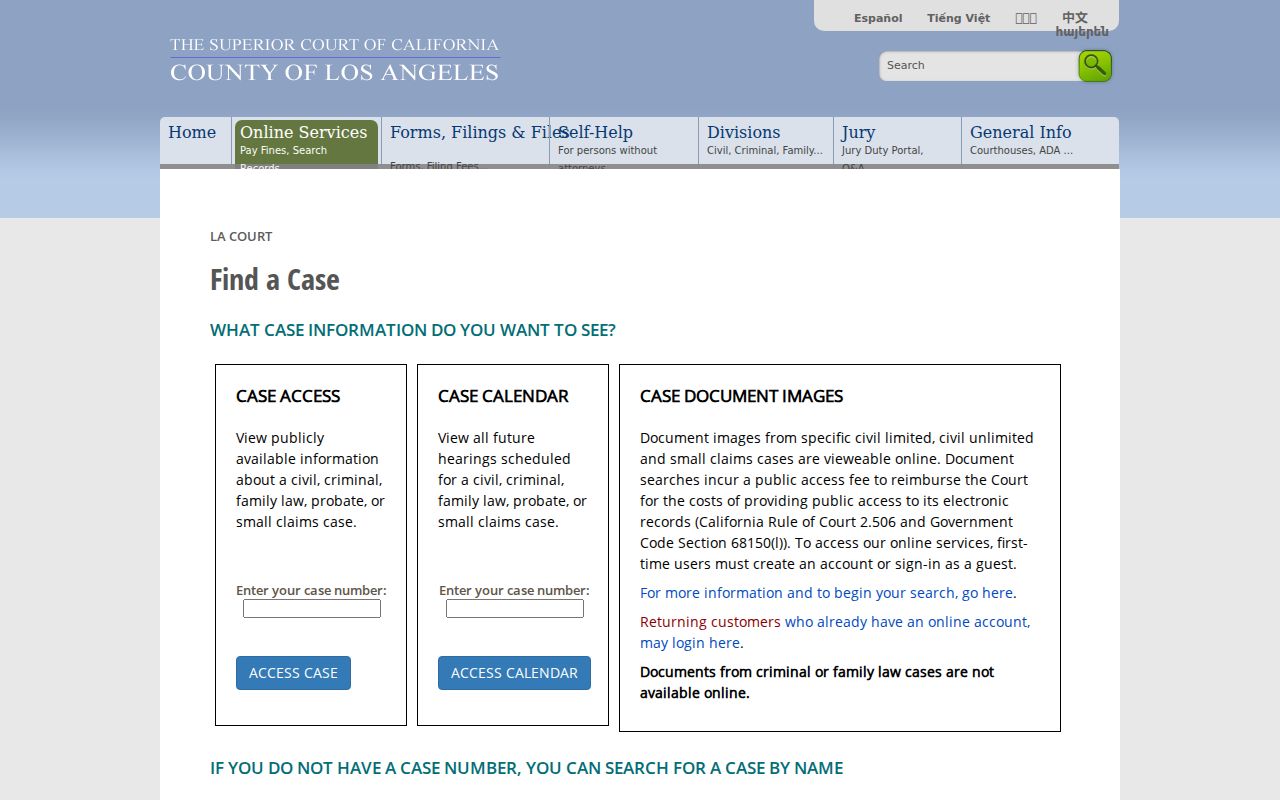
The example is not statewide coverage. Its result must be read as one county court's index, with the source file still held by that clerk.
Use the County Directory for all 58 California counties to reach the right local court and criminal-record channel. For an arrest narrative or booking, contact the arresting agency or county jail separately. For a fingerprint-linked review of one's own statewide record, use CA DOJ instead of treating a court name search as a rap sheet.