
Running a Sex Offender Check in California
California maintains two connected systems. The California Sex and Arson Registry, known as CSAR, is the law-enforcement repository. The California Megan's Law Website is the public disclosure layer drawn from CSAR. The public layer shows only information authorized by Penal Code section 290.46. It does not expose every person, address, or fact held in the full registry.
That split matters during a California sex offender check. Local police and sheriff agencies create and update registrations. CA DOJ publishes approved data each day. A public result may show a full street address, a ZIP code or community, or only a county for a person registered as transient. Some people remain required to register but qualify as No Post or are omitted under a statutory exclusion. A careful search treats the website as a safety resource, not as a complete criminal history.
California Registry Search Radius
Address mode supports four distances: .75 miles, 1 mile, 2 miles, and 5 miles. Two miles is the default. A narrow search can help with a specific block, while a broader radius can reveal entries just outside the first boundary. The portal warns that Google geocoding can affect placement. If an expected result does not appear, check the street spelling and city, then increase the radius.
Location modes also include city, county, and five-character ZIP code searches. Results display 25 entries at a time and can be sorted by name, city, ZIP, or county. California does not provide a statewide email or address-proximity alert through this portal. The national NSOPW search is the official supplement when a search must cross state lines.
Note: A wider California radius can correct a geocoding miss, but it does not add people excluded from public website disclosure.
How to Search the California Megan's Law Website
The search begins at the official California Megan's Law disclaimer. A user must check “I have read the disclaimer and agree to these terms and conditions” and select Continue. The site also states that a person required to register under section 290 may not enter the search function. Violating that entry rule may bring a fine of up to $1,000, up to six months in county jail, or both.
- Accept the official disclaimer and choose Continue.
- Select Address, Name, City, County, or ZIP Code from Search Type, then choose Go.
- Enter every required field for that mode and complete any CAPTCHA shown.
- Open a result and compare the photograph, aliases, age, and physical description before drawing a conclusion.
| Field or control | Type | Required | California portal behavior |
|---|---|---|---|
| Search Type | Dropdown | Yes | Address, Name, City, County, or ZIP Code; Go loads the mode |
| Street # and Street Name | Text | Address mode | Both fields accept free text |
| City | Autocomplete | Address or city mode | Prefix match returns up to 10 California suggestions |
| ZIP Code | Text | Address or ZIP mode | Exactly five characters |
| Radius | Dropdown | Address mode | .75, 1, 2, or 5 miles; 2 miles is default |
| Transient option | Checkbox | No | Adds transient records to list results only |
| First and Last Name | Text | Name mode | Current form marks both as required |
| County | Autocomplete | County mode | Prefix match covers all 58 counties |
| Map / Display List | Toggle | No | Switches the result view; transients stay list-only |
Transient California Registry Results
A transient registration has no residential street address to place on a map. California therefore shows transient entries in the list, with the county of registration, but not as map pins. Searchers must select the transient checkbox in address, city, or ZIP mode to bring those entries into the result set. This is an intentional display rule, not proof that the entry is incomplete.
Transient registrants report to the local registering agency every 30 days. Most other registrants update annually within five working days before or after their birthday. Sexually violent predators update every 90 days. A violation indicator on a public profile reflects the update schedule reported to the system. It is not a separate conviction and should not be described as one.
Note: Map position, list presence, and registration compliance answer different questions in a California registry search.
Inside a Registry Profile
A California Megan's Law profile helps distinguish people with similar names. It can also show how state disclosure law limits the result. The registry lists registrable offenses, not every arrest or case in a person's history. Victim identity, unrelated criminal history, and law-enforcement-only registration details do not belong on the public page.
| Name and aliases | Display name and known alternate names supplied for public disclosure |
|---|---|
| Photo and description | Photograph, sex or gender, race, age or birth date, height, weight, eyes, hair, and identifying marks when available |
| Location category | Full address, city and ZIP, or county of registration for a transient entry |
| Registrable offense | Offense description, code section, and available conviction or jurisdiction details |
| Update status | Registration status or reported violation indicator and update context where displayed |
| Risk information | SARATSO or Static-99R risk information where disclosure is authorized; this is not the statutory tier |
Note: California registration tier is not displayed in the inspected public profile, so do not infer it from address detail or risk information.
California Registry Posting Categories
California's official daily count shows why a public search is not a census. On August 9, 2026, the Megan's Law statistics page counted 73,855 community registrants across four disclosure categories. Of those, 61,208 were in the publicly searchable Full Address and ZIP Code groups. Another 12,647 were No Post or omitted under section 290.46. The tally excluded incarcerated and deported registrants.
| Disclosure category | Community registrants | Meaning |
|---|---|---|
| Full Address | 55,097 | Street address publicly disclosed under the statutory category |
| ZIP Code | 6,111 | Community or ZIP disclosed without the exact home address |
| No Post | 11,379 | Registration continues, but the public profile is not posted |
| Omitted | 1,268 | Statutory exclusion from website display |
The official California registry statistics change daily. “No Post” does not mean failure to register. An omitted record does not mean the underlying duty ended. A no-result search should never be treated as proof that no registrant or safety concern exists.
California Registration Requirements and Levels
California moved from an adult lifetime-only system to tiered minimum periods under SB 384. Tier duration is separate from website visibility and separate again from a SARATSO risk measure. The minimum starts after release from incarceration, placement, commitment, or specified supervision. Later custody can pause the clock, while a new registrable conviction or failure-to-register conviction can change it.
| Classification | Adult minimum | Juvenile minimum | Core rule |
|---|---|---|---|
| Tier One | 10 years | 5 years | Generally qualifying misdemeanor and non-serious or nonviolent felony offenses |
| Tier Two | 20 years | 10 years | Enumerated serious, violent, repeat, or other section 290(d)(2) criteria |
| Tier Three, offense or status | Life | Statute-specific | Enumerated offenses, specified status, or repeat criteria |
| Tier Three, risk only | Petition after 20 years | Not listed | Limited risk-only group, subject to exclusions |
| Tier To Be Determined | Continues | Continues | Registration remains while DOJ completes assignment |
Completing a minimum does not automatically end registration. An eligible person must petition the Superior Court in the county of current registration under section 290.5. The court and prosecutor review the request. Tier, public posting category, and risk score remain three distinct parts of California law.
Note: A California tier minimum creates petition eligibility; the registration duty continues unless and until the court grants termination.
Correcting California Registry Information
Local police and sheriff agencies are the first stop when a California registry address, status, or identity detail appears wrong. DOJ also accepts website-error reports at MegansLaw@doj.ca.gov. Provide the exact non-sensitive fact that needs review. Do not contact or confront the person shown. Mistaken identity is possible, and registry data can change faster than a saved image or old result.
A person newly released to the community must register with the law-enforcement agency having jurisdiction over the residence within five working days. Residence changes and becoming transient follow the same five-working-day clock. Local agencies forward changes to DOJ, which refreshes the public site daily. Use the California County Directory to reach the correct local registration channel. The underlying conviction remains in the relevant Superior Court file.
California Registry Update Clocks
Three time frames are easy to confuse. Five working days applies to initial community registration and changes of residence or transient status. Thirty days is the update cycle for a transient registrant. Ninety days is the update cycle for a sexually violent predator. Most other registrants update annually around their birthday. Registration and updates carry no fee under Penal Code section 290.012(d).
California enacted the nation's first sex offender registration law in 1947. Public web disclosure followed legislation in 2004 and service began in 2005. Tier rules took effect in 2021, with related display changes in 2022. Those milestones explain why older assumptions about lifetime duration or universal address display may no longer match the current system.
Registration records also contain law-enforcement fields that the public website does not display. California agencies collect a current photograph, fingerprints, signed acknowledgments, vehicle plates, required internet identifiers, workplace information for official use, and proof of residence. Keeping those items out of a public profile is deliberate. The Megan's Law result is a disclosure record shaped by section 290.46, not a copy of the full CSAR registration packet.
Lawful Use of Registry Data
California Megan's Law information is for protecting a person at risk. Penal Code section 290.46 forbids using it for threats, intimidation, harassment, or crime against a registrant or family. It also creates civil liability for unauthorized use. The sound approach is to verify identity, keep the statutory display limits in mind, and report an immediate concern to the law-enforcement agency with local jurisdiction.
The official legal-use screen shows the mandatory terms before access. The captured California Megan's Law warning illustrates that lawful entry and careful use are part of the search itself.
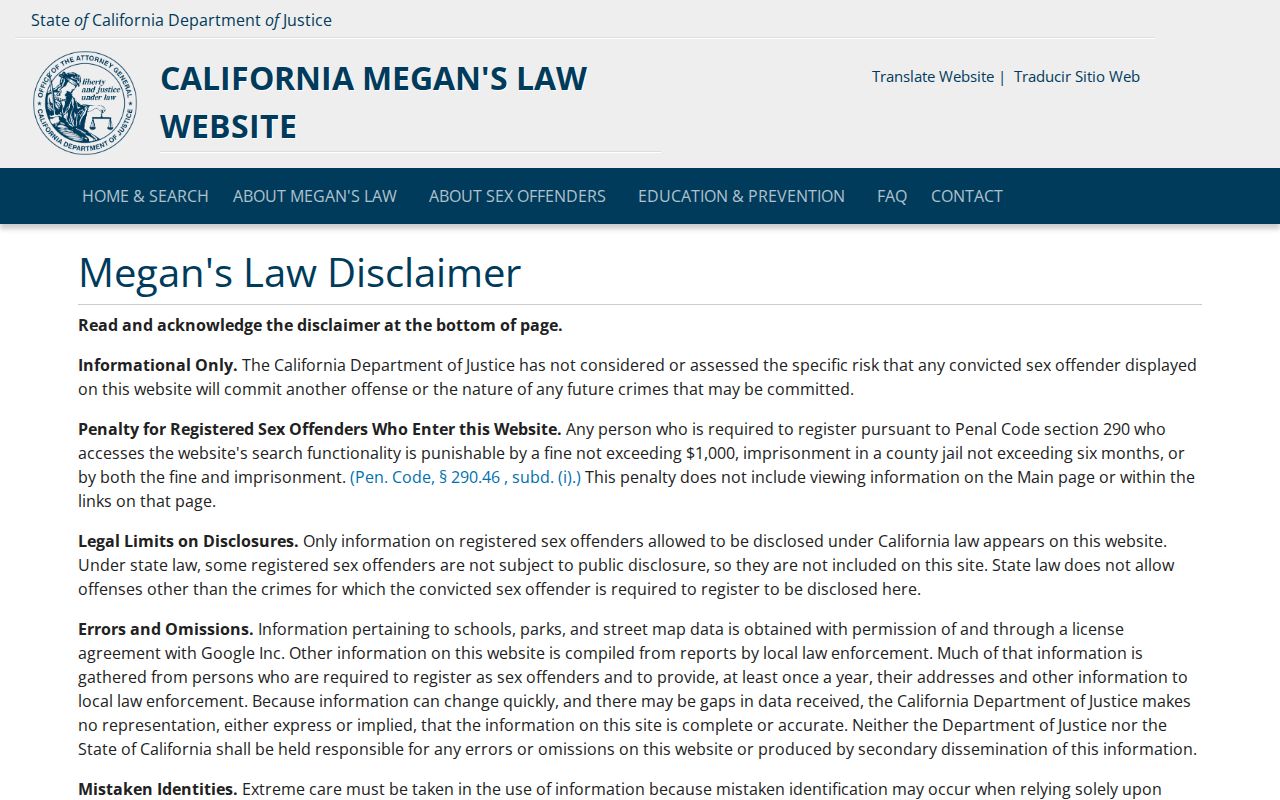
The warning sets the registry's purpose before any name, address, or county result appears.
Misuse is a crime. Using disclosed information to commit a misdemeanor can add a $10,000 to $50,000 fine. Using it to commit a felony can add a consecutive five-year term under California Penal Code section 290.46.